13
Oct
20
Before we had retina displays and AI image generators, there was a time when pixels were not a nostalgic aesthetic — they were the only option. The 1990s gave us jagged edges, visible grids, and a new visual honesty. That constraint became a language, and for three Berlin designers — Kai Vermehr, Steffen Sauerteig, and Svend Smital — it became a calling. They didn’t just accept the pixel; they worshipped it.
For me, as someone who grew up surrounded by slick 3D renders and photorealistic design tools, pixel art feels almost rebellious now. It’s the rejection of excess, a return to discipline. What started as technological limitation turned into philosophy. eBoy made that transformation look effortless — like monks designing stained glass, only their glass was made of squares.
It’s hard to imagine now, but in 1997, designing only for screens was considered a creative suicide. “How will you print it?” people asked. eBoy didn’t care. Their art was born digital, designed to live and breathe on the monitor, not paper. They shared their first works on floppy disks, passed between fans like contraband. When the internet finally caught up, eBoy were already there, fully formed — pixel-perfect prophets of a new visual faith.

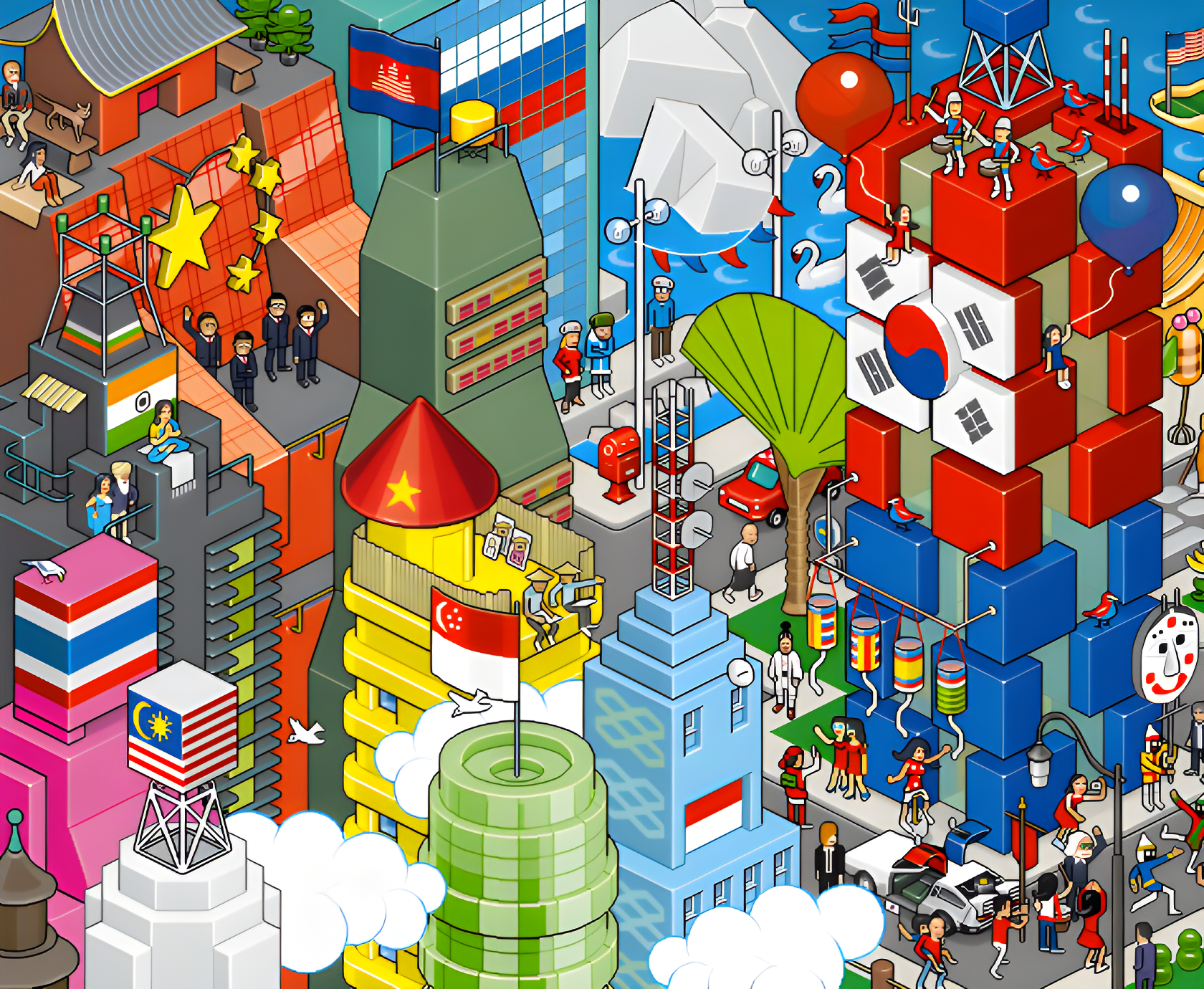
At that time, the web was raw and chaotic. eBoy’s 3D isometric cityscapes looked like order within chaos: robots climbing skyscrapers, monsters rampaging through shopping malls, half-naked figures hanging from poles. It was pop culture compressed into geometry — absurd, funny, and shockingly precise.
Today, eBoy operates from Berlin and Vancouver. There’s no office, no hierarchy — just three screens, three minds, and an endless grid. Their workflow is almost meditative. They start from a single pixel, expand it into a neighborhood, then a city, then a world. Every object, every shadow is handmade. No AI. No shortcuts. Just patience.

I once heard a quote from them that stuck with me: “We like to build stuff.” That’s all. No manifesto, no grand statement — just the joy of constructing universes from colored squares. As a designer, I envy that purity. Their process feels like slow cooking in an age of microwave aesthetics. Every building, every traffic jam, every hidden joke in their artwork carries that human imperfection that no neural network can mimic.
eBoy’s cityscapes are like visual jazz — meticulously composed yet full of surprises. Look closely and you’ll find robots fighting dinosaurs next to office workers grabbing coffee. There’s an internal logic to it all, even if it’s chaotic. The aesthetic is rooted in video game culture — 8-bit, isometric, layered with irony — but elevated into architectural design. It’s both fun and frighteningly precise, a reminder that playfulness and structure can coexist.

As someone who studied industrial design, I see parallels between their work and urban planning. There’s a rhythm to their cities, a circulation of people, color, and geometry. They turn consumer culture — billboards, cars, fast food — into something almost sacred. It’s design as social commentary disguised as fun.
It’s funny how purity attracts corporations. Over the years, eBoy collaborated with MTV, Coca-Cola, Honda, and Xbox. Big brands wanted a piece of their digital DNA — that mix of nostalgia and chaos. But even in those commercial projects, eBoy never lost control of their voice. The art came first; the logos just rented space inside it.
They once said working for brands didn’t feel like compromise, because the grid itself was their rulebook. Within that 8-bit structure, they could stay authentic. And perhaps that’s the genius: they built a visual system so strong that no client could break it. That’s a kind of freedom most designers never reach.
Now, in 2025, we live in the age of infinite resolution and generative perfection. But ironically, the world feels less human. eBoy’s work hits differently now — raw, deliberate, unapologetically manual. It reminds us that creativity thrives within boundaries. A single pixel, chosen intentionally, means more than a thousand AI-generated gradients.
“Perfection isn’t when there’s nothing left to add, but when there’s nothing left to take away.” — Antoine de Saint-Exupéry
eBoy proved that philosophy decades ago. Their art is timeless not because it’s trendy, but because it’s honest. As designers, maybe we need that honesty again — one pixel at a time.