18
Apr
25
By 2025, Bluetooth speakers are everywhere — small, smart, waterproof, voice-controlled. But rewind a decade, and they were just boxes. Loud, yes. Portable, sure. But hardly inspiring. Then came a small Californian company called Om Audio, who asked a wonderfully unnecessary question: what if sound could float?
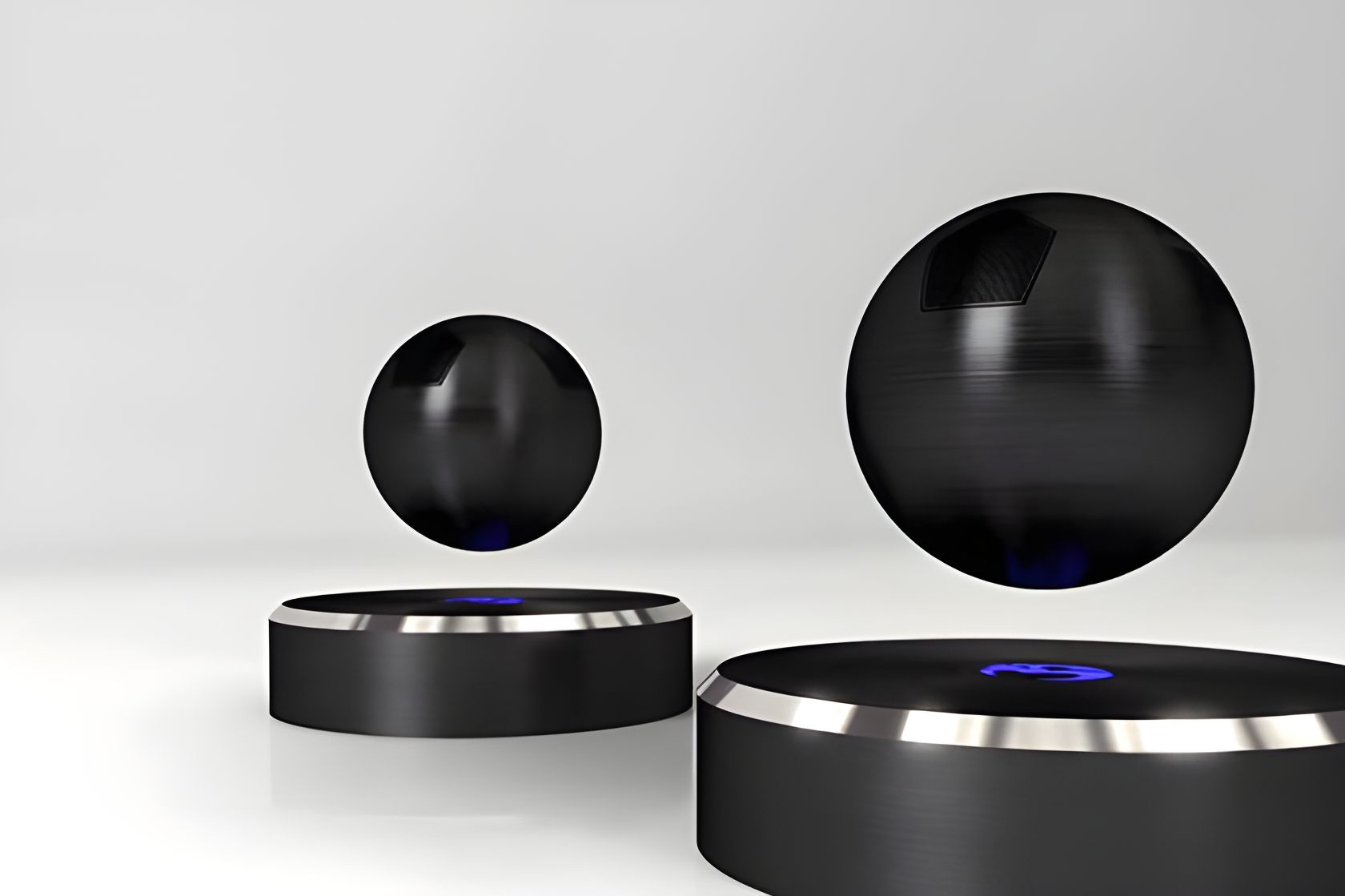
Their answer was Om/One — a levitating Bluetooth speaker that didn’t just play music, but danced with it. At first glance, it looked like magic: a glossy black or white sphere hovering above its base, spinning gently in midair while playing your favorite track. You didn’t just hear the music — you watched it move.
In a world of flat rectangles and predictable forms, that alone felt revolutionary. People suddenly saw sound, not just heard it. It was a statement piece, a conversation starter, and, let’s be honest, the kind of gadget you showed off before you even switched it on.
Om/One was born out of a mix of curiosity and ambition. The team behind it — designers and engineers from Om Audio — wanted to merge acoustic precision with emotional spectacle. They didn’t want to compete with JBL or Bose on specs. They wanted to create an experience.
Crowdfunded in its early days, Om/One quickly became a phenomenon. Backers didn’t just want better sound; they wanted to own a piece of the future. Within weeks, the project raised more than twice its target — a clear sign that the world was hungry for design that makes you feel something again.
And to their credit, Om Audio delivered. The prototypes worked. The sphere really levitated, powered by a carefully tuned electromagnetic base that kept it steady even while spinning. It wasn’t a trick — it was physics, wrapped in poetry.
So, how does something like that even work? The secret lies in magnetic levitation — the same principle that keeps maglev trains hovering above their tracks. Inside the base are powerful electromagnets that create a magnetic field. The speaker sphere has embedded magnets aligned precisely to resist that field, creating a stable, floating balance point.
The sphere spins slowly as it hovers, which isn’t just for show. That rotation helps stabilize it and evenly distribute sound in 360 degrees. When you pull it off the base, it instantly becomes a portable speaker, complete with a built-in battery that lasts around 15 hours — impressive even by today’s standards.
It also doubles as a speakerphone, thanks to an integrated microphone. The idea was simple: when it’s home, it floats; when you go out, it comes with you. It’s one of those rare designs that felt both futuristic and surprisingly practical.
The magic of Om/One wasn’t just in its levitation. It was in how it made you feel. Traditional audio gear tends to hide — tucked into corners, disguised as furniture. Om/One refused to disappear. It demanded attention. It made listening a spectacle.

That decision — to design for emotional resonance, not just technical performance — marked a turning point in consumer design. The spherical shape wasn’t random; it was an aesthetic and acoustic choice. The curved form helped distribute sound naturally, while the hovering motion transformed sound into sculpture.
I remember the first time I saw one in person at a design expo in London. People crowded around it, phones out, mesmerized. Nobody asked for specs; they asked, “How is it floating?” That’s how you know a design has succeeded — when it makes people curious again.
You’d expect a levitating gadget to sacrifice performance for the wow factor, but Om/One surprised critics. It wasn’t just a novelty — it actually sounded good. Deep bass, clear mids, smooth highs. Not audiophile-grade, perhaps, but rich and balanced enough to fill a room with warmth.
Its battery endurance — up to 15 hours of playback — was ahead of its time. The materials felt premium, the touch controls intuitive. And sure, it cost more than the average speaker, but it wasn’t trying to be average. It was a design object, a collectible piece of technology that blurred the line between audio equipment and kinetic sculpture.
That’s why even today, you’ll still find them on eBay — sometimes still hovering perfectly, ten years later, as if defying both gravity and obsolescence.
Looking back from 2025, Om/One feels like a relic from the future — a preview of where design was heading all along. It hinted at a world where objects wouldn’t just serve functions, but tell stories. Where everyday technology could surprise us again.
Maybe the best kind of technology isn’t the one that hides in the background, but the one that makes you look up — and say, “Wait, how does that even work?”
Now we see levitating lamps, floating turntables, magnetic planters — the descendants of the same idea. Om/One didn’t just change Bluetooth speakers; it reintroduced wonder into product design. In a time when most gadgets are predictable, that’s something we sorely need.