26
Aug
25
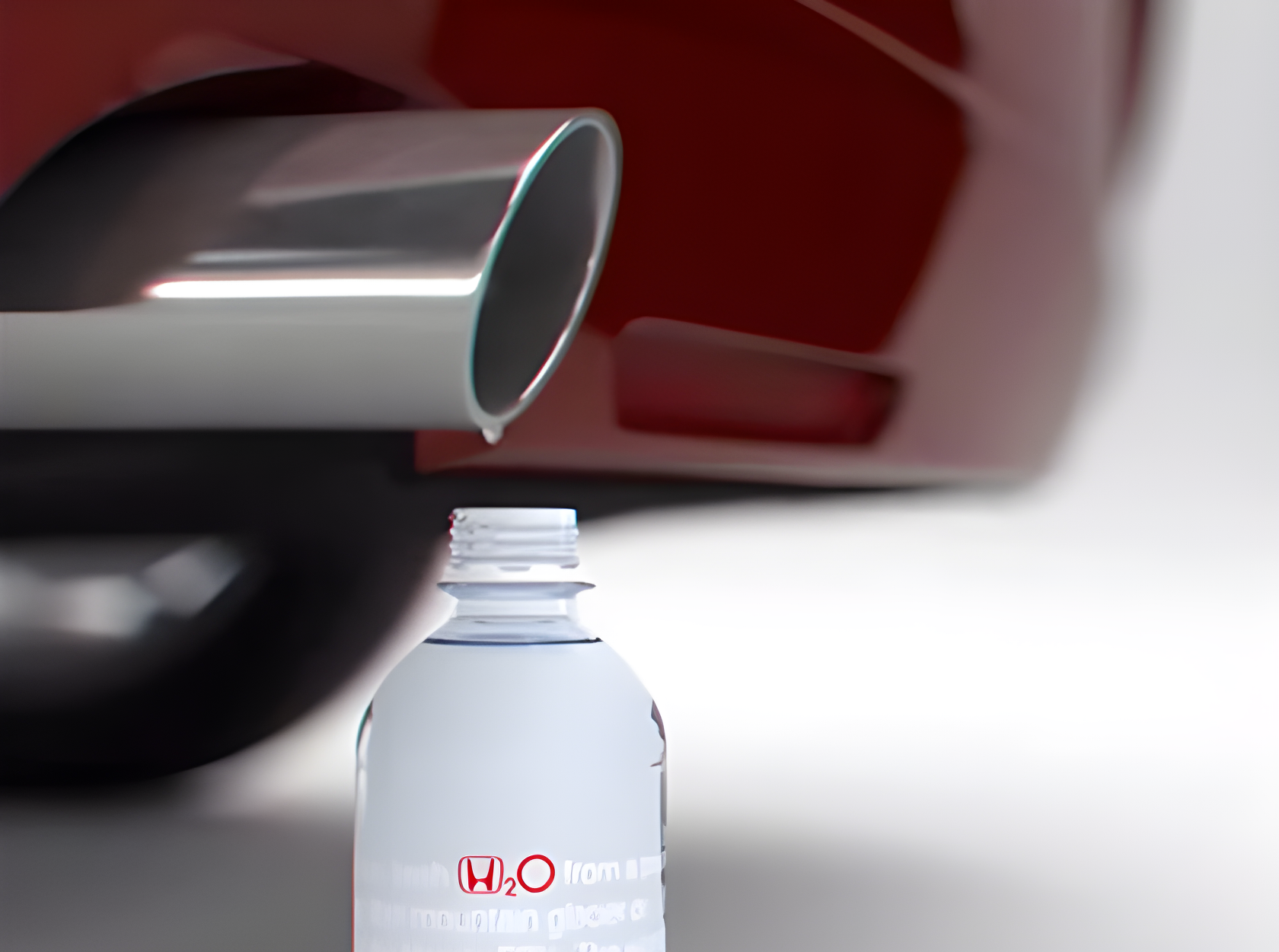
It’s 2025, and Honda has done something that sounds like science fiction. The FCX Clarity, a hydrogen-powered car, doesn’t just reduce carbon emissions — it produces pure water as its only exhaust. And not just any water: Honda bottles it under the H2O label, FDA approved, and claims you can actually drink it. At first, it seems absurd. You might imagine yourself sipping from the tailpipe on a desert road. But once you look closer, it’s a clever way to communicate how hydrogen fuel cells work and what sustainability can actually mean in a tangible way.
This isn’t merely a stunt. By turning emissions into drinkable water, Honda demonstrates the practical, almost poetic result of hydrogen technology. It’s an educational, visceral experience that blends science, design, and marketing into one surprising gesture. And while many will chuckle at the idea, it forces us to rethink what “car emissions” even signify in 2025.
The FCX Clarity uses compressed hydrogen, combining it with oxygen in a fuel cell to generate electricity, heat, and water. This water is essentially distilled, ultra-clean, and safe to drink — hence the H2O bottled campaign. The design team integrated a small collection tank on the exhaust, transforming it into a mobile purification system. Engineers had to ensure not only safety and compliance but also taste, clarity, and bottling logistics. In practice, driving the car in Death Valley or across the Thar Desert could literally hydrate a driver with the exhaust itself.
The marketing brilliance here is obvious: the process takes something traditionally negative — emissions — and turns it into something positive, tangible, and almost playful. It’s an intersection of engineering, sustainability, and human experience, which is precisely the kind of story designers love to analyze.
Despite the allure, there are real-world considerations. Hydrogen refuelling stations remain sparse and expensive to build, limiting adoption. The FCX Clarity is not cheap — it’s a premium vehicle, more a statement than a mass-market solution. Still, companies worldwide are racing to produce hydrogen vehicles, and Honda’s approach shows the potential beyond simply reducing carbon footprints. Even if you never drink the H2O directly, the innovation represents a design-minded approach to environmental storytelling and problem-solving.
From a designer’s perspective, infrastructure and user experience are critical. How does the car feel when fueling? What does the dashboard convey about water output? Can the user integrate the experience into daily life? Honda’s work raises these questions, pushing us to see mobility as a holistic, multi-sensory design challenge.
Hydrogen cars are more than technology; they’re design exercises in efficiency. The FCX Clarity’s interior reflects a balance between minimalism and functionality, echoing the precision of its fuel cell system. Each surface, gauge, and control communicates sustainability and modernity. Integrating water collection required creative problem-solving, aligning mechanical function with human interaction.

Engineers collaborated closely with designers to ensure that producing drinkable water didn’t compromise cabin space, ventilation, or aesthetic appeal. This approach is a blueprint for future vehicle design: technological performance and user experience are inseparable. In many ways, the H2O campaign is as much about design thinking as it is about environmental innovation.
Reactions are mixed. Some critics laugh, others are impressed, but most are intrigued. The combination of humor, science, and sustainability captures attention in a way few automotive campaigns can. It turns a technical explanation into a narrative, almost a short story: the car you drive literally gives you water. Social media amplifies the concept, and while adoption is slow, awareness is high.
From the design lens, public reception is as informative as engineering performance. It shows which ideas resonate, which feel credible, and which push the envelope. Honda H2O becomes a case study in experiential marketing, demonstrating how a product can tell its own story while remaining rooted in real technological innovation.
Looking forward, Honda’s experiment points to broader trends. Cars might increasingly serve dual roles: transport and environmental solution. Designers and engineers must consider every output — energy, water, heat — as part of the user experience. Campaigns like H2O suggest mobility isn’t just about getting from point A to B; it’s about interaction, sustainability, and narrative.
Hydrogen-powered vehicles are still a niche, but they represent a paradigm shift. By 2025, we can imagine hybrid experiences where emissions are resources, where vehicles integrate seamlessly into ecological and social systems. Honda’s playful, provocative, and thoughtful approach exemplifies this emerging philosophy: engineering isn’t just functional; it can be edible, drinkable, and downright fascinating.