30
Jul
25
There are few things that can sour your mood faster than a crowded parking lot. Whether it’s circling around aimlessly or squeezing into a space that feels one size too small, the act of parking has long been one of those human inconveniences we simply tolerated. But tolerance tends to fade when technology begins to offer better solutions. By 2025, automation isn’t just about luxury vehicles or smart homes — it’s about reclaiming small moments of life we’ve wasted for decades. And that’s where Ray enters the picture.
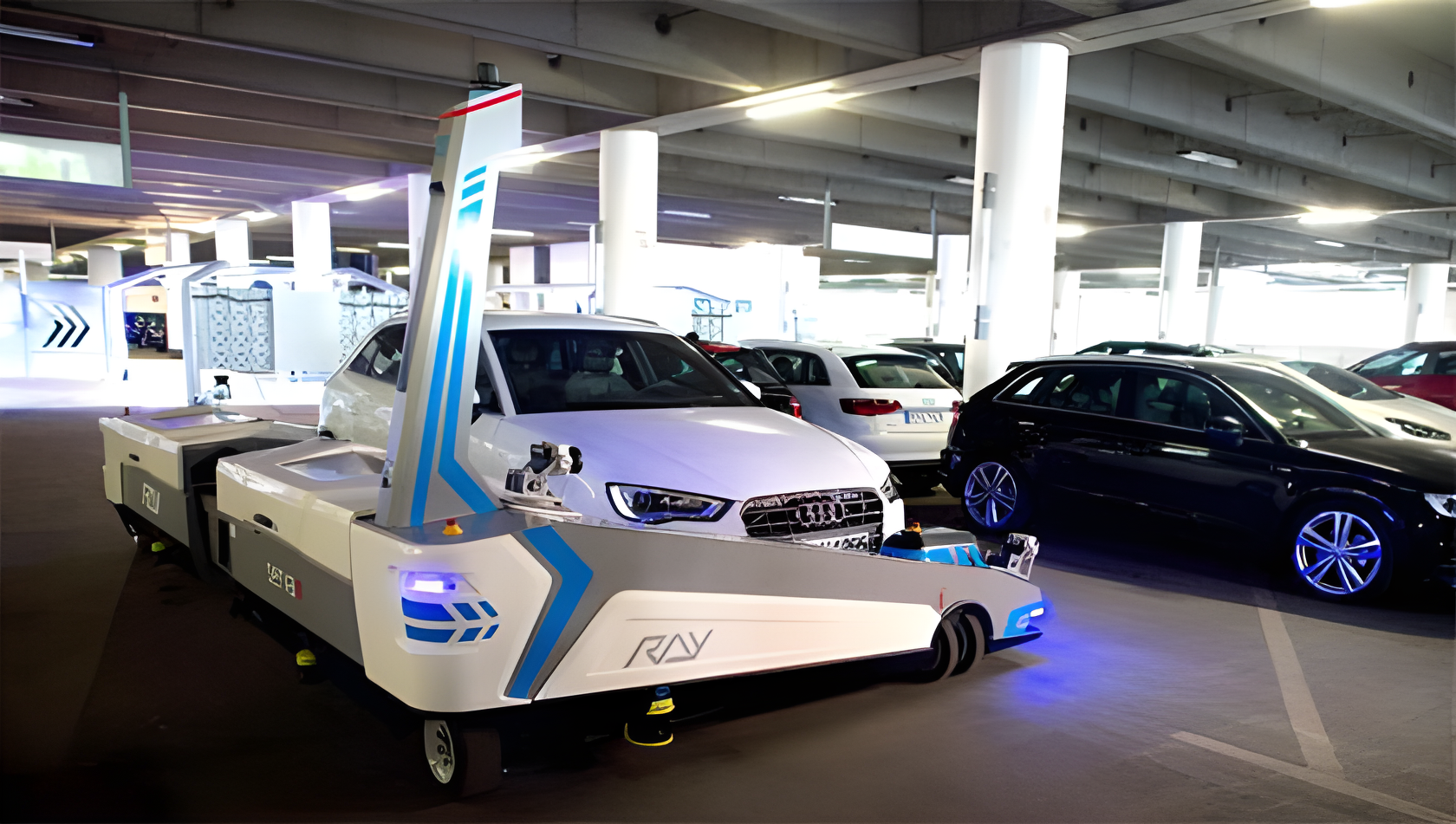
At Düsseldorf Airport, travelers were the first to meet Ray — a quiet, polite robot valet that looks more like a futuristic forklift than a car. It doesn’t chat, it doesn’t honk, but it performs its job with surgical precision. Developed by Serva Transport Systems, Ray was designed to pick up vehicles at the terminal and park them safely without a single scratch. You simply drop your car in a designated area, confirm your flight details, and Ray takes over. The system calculates how long your car will stay and finds the most efficient spot to store it, optimizing every meter of parking space.
In practice, Ray feels less like a robot and more like a calm professional who knows exactly what he’s doing — the kind of valet who never gets flustered and always remembers where he parked your car.
Ray’s intelligence lies in its sensors, cameras, and software. It maps the parking zone in real time using laser-based guidance and 3D imaging, avoiding collisions and navigating tight corners with almost human intuition. Unlike cars with self-parking features, Ray doesn’t need your car to be smart — it lifts it entirely and moves it as an object, not as a vehicle. That design decision is genius because it decouples the automation from the car industry itself. You can drive an old Mini or a new electric SUV — Ray doesn’t care. It treats them all equally.
It’s a fascinating blend of industrial design and software logic. There’s something oddly poetic about watching a metal machine gently cradle your car and disappear into the parking maze like it’s tucking it in for a nap.
“Design isn’t just about what we see — it’s about what we no longer have to do.”
Even after years of development, there’s still a moment of disbelief watching Ray glide silently across the floor. It’s that same childlike feeling you get from your first encounter with a drone or a robot vacuum — except now, it’s full-sized and moving your car. The emotional response is part of the design. The way the robot moves — slow, deliberate, symmetrical — makes it seem alive in a strangely comforting way. This is design psychology at work: form following not just function, but empathy.
People have started trusting machines not because they’re flawless, but because they’re predictable. And predictability, when you’re rushing to catch a flight, is a blessing.
What’s often overlooked is the interface — the part where humans and robots meet. Ray’s system includes a simple touchscreen kiosk and an app that syncs with your flight. If your return gets delayed, Ray automatically adjusts the car’s position in the parking grid. You never have to call anyone or explain anything — it just knows. That kind of quiet intelligence is design done right: invisible, functional, and stress-free.
There’s an elegance in creating technology that doesn’t demand your attention but still earns your trust. That’s the lesson designers — myself included — keep coming back to.
When Ray was first introduced, it felt like a novelty. Today, similar systems have started to appear in Japan, Dubai, and Singapore — not just at airports but in residential complexes and malls. The evolution wasn’t just about copying the idea, but adapting it to local needs. Some cities integrated solar power and modular parking units; others paired AI scheduling with public transport data to reduce idle cars altogether. Ray’s DNA — the concept of spatial efficiency and human relief — has quietly reshaped how we view parking.
It’s less about parking and more about trust — trusting automation to handle a part of our lives with dignity and care.
Designers like to talk about the “invisible interface,” where the best experience is the one that fades into the background. Ray is exactly that. It’s not the kind of design you post on Instagram, but the kind that subtly redefines behavior. People arrive calmer. Depart faster. Complain less. You don’t notice the design — and that’s its success.
Maybe that’s where we’re heading: toward a world where design quietly steps aside and lets life flow better. Ray just happens to be one of the first to show us how that looks.