09
Mar
22
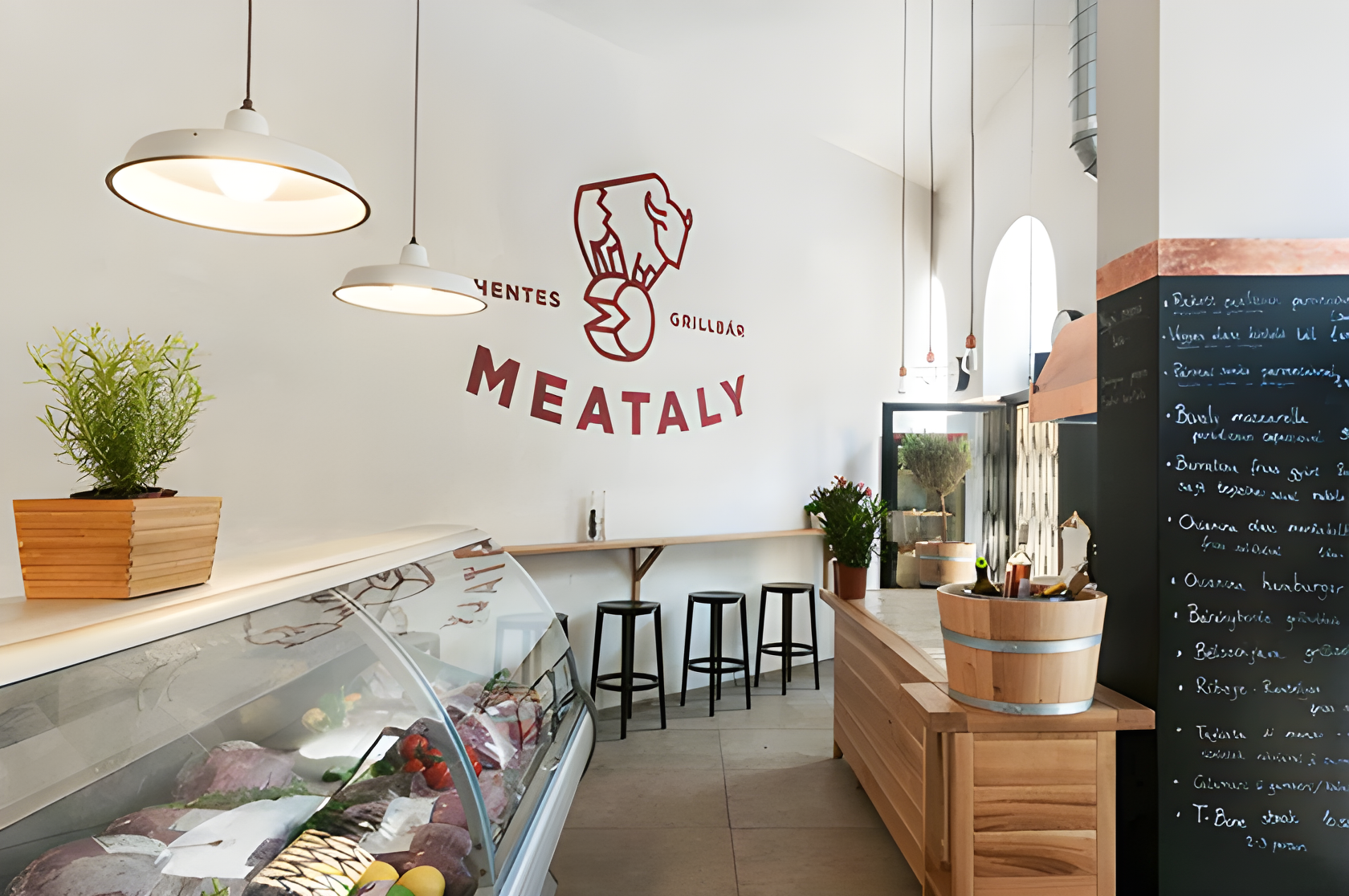
In the heart of Budapest, on Bajcsy-Zsilinszkiy street, sits a small 45 m² Italian butcher & grill bar named Meataly. Designed by Hollán9 Studio, it’s a project that quietly redefines what a dining space can be. It isn’t just a place to eat: it’s a crafted environment where brand, craft and ritual converge. From the moment you step in, you sense that the space has been thought through—every surface, every texture, every element has meaning.
As a furniture and interior designer myself, I often focus on chairs, tables and materials. But here, the architecture and interior design tell a complete story. It’s rare to find such coherency in a small space: a logo, wall-painting, pattern design and service area all choreographed to evoke both Italian butchery and modern grilling culture. The result is humble yet distinct—something I value highly.
Hollán9 Studio didn’t simply fill a room—they built a narrative. Meataly’s interior features design gestures that reference traditional butcher shops: tile motifs, hanging cured meats, raw-edge wood shelves. At the same time it elevates the experience: lighting that highlights the char-grill, wall-paintings that inject energy, a logo that anchors the brand quietly. The 45 m² space becomes theatrical but not theatrical in a showy way—it’s subtle, rich and layered.


I visited Meataly on a brief trip to Budapest and I remember one moment clearly: the metal mesh overhead that carried ambient lighting and suspended cured items—it silently said “craft”, “authenticity”, “grill”, “butcher” without a word. That moment stuck with me, because it’s design behaving like a memory rather than a product.
What’s especially fascinating is the interplay of materiality and visual branding. The wallpaper pattern and wall-painting (conducted by designers such as Gergő Óvári and Tímea Ferth) merge tile motifs and graphic abstractions of meat cuts and grill marks. On Behance you’ll find the project labeled “MEATALY—wallpaper pattern and wall-painting 2015”.
Wood surfaces, concrete floors, matte black metal fixtures—these materials speak in the language of both workshop and lounge. The branding uses strong serif typography and a subdued palette of green, black and natural wood. Together, the visual identity and the physical space align to create trust: you feel you are in a place that knows what it does, that cares.
Design is not just about objects—it’s about behavior. At Meataly, the spatial arrangement invites hanging out: you can lean against the butcher counter, watch the grilling, chat with the staff, linger with a drink. The environment resists the rush-in, rush-out model of modern fast-food. It offers a rhythm of pause, of craft, of assembly.

From my own pattern shops to interior exhibitions I’ve done, I’ve realized one thing: space dictates movement. At Meataly the design subtly guides you: first you see the branding, then the grilling station, then the seating area—and you end up staying. That kind of choreography is rare in hospitality at this budget and scale.
Here are a few take-aways from Meataly that I keep returning to:
For designers of furniture or interiors, this means remember that your work doesn’t exist in isolation—it’s part of someone’s ritual, their habits, their story. Meataly reminds us that design can quietly orchestrate that relationship.


The best spaces don’t try too hard—they just know.
As a 23-year-old designer working across furniture, interiors and industrial design, I found Meataly’s coherence inspiring. It showed me that design doesn’t need gimmicks to stand out. It needs honesty, care and story. Next time you sit at your desk, make something that invites, rather than demands. Make something that belongs, rather than shouts.


In reviewing Meataly, I felt a reminder: my work should aim not only for form or function, but for rhythm—how someone arrives, sits, interacts, leaves. If I take one lesson from this project it’s this: design is as much about the spaces between actions as it is about the objects themselves.