16
Apr
24
Ever since I was a kid, I had this weird fascination with the idea of disappearing completely, like Harry Potter and his invisibility cloak. The fantasy of moving unseen, untracked, unbothered has always appealed to me, even if I was never fully invested in wizardry. In the real world, invisibility isn’t about magic wands but about controlling what the world sees—or more importantly, what it doesn’t. Fast forward to 2025, and suddenly the dream isn’t as far-fetched as it seemed in my school days.
Coop Himmelblau, an Austrian architecture firm known for pushing boundaries, decided to translate that fantasy into a tangible object: a wearable cloak that hides you from the digital eye. It’s part science, part fashion, part high-tech gadgetry, and entirely intriguing. As someone who spends a lot of time thinking about space, form, and function, I find this intersection of wearable design and digital privacy a fascinating playground for ideas.
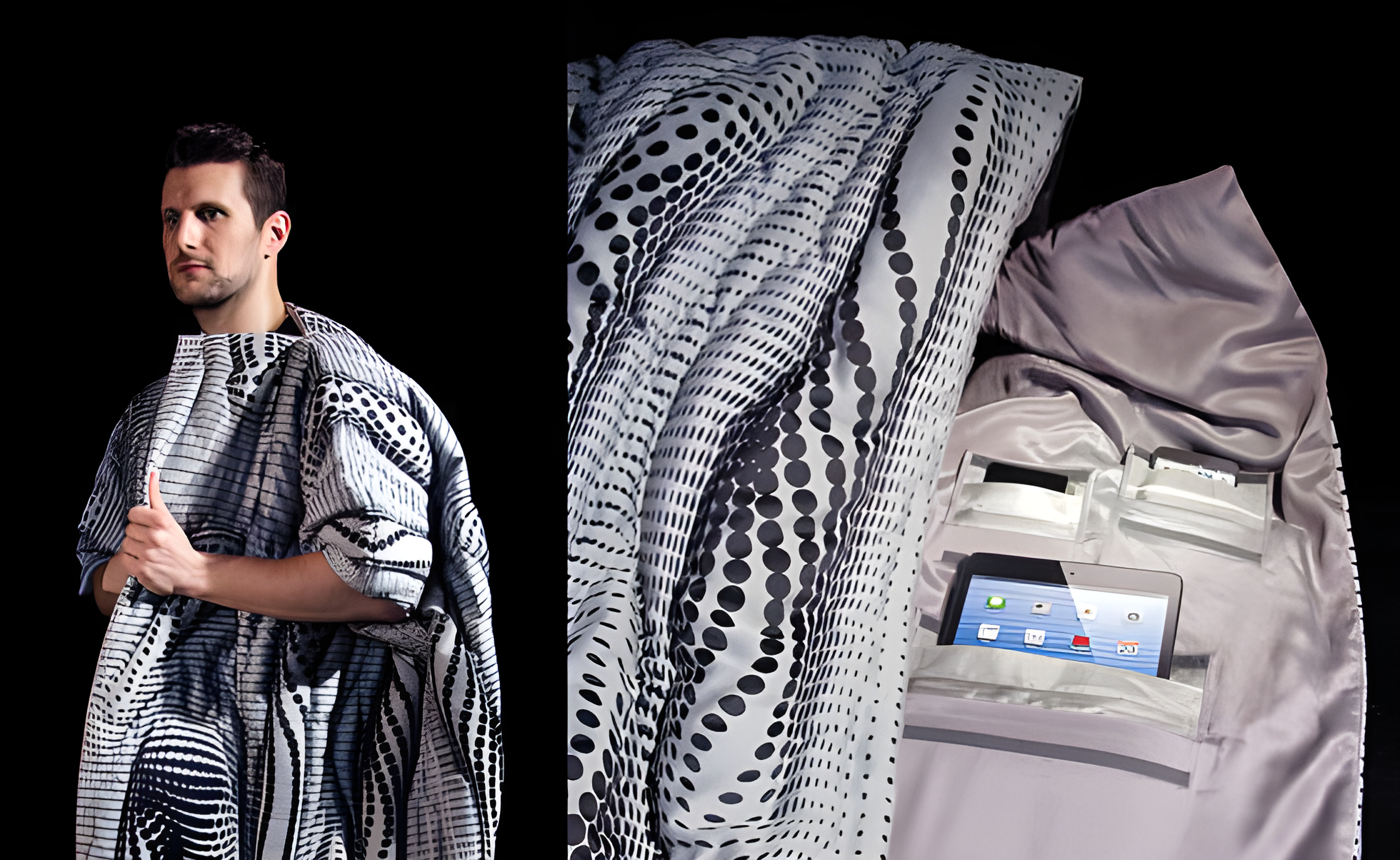
The CHBL Jammer Coat, as it’s called, isn’t a Harry Potter replica. Instead, it’s a metallic-fiber garment that blocks any radio waves from entering or leaving its vicinity. That means your devices, credit cards, even digital identifiers are shielded while you’re inside it. In essence, the cloak creates a bubble of untraceability—a personal invisibility zone in a hyper-connected world. Wolf D. Prix, the CEO of Coop Himmelblau, frames it as a choice: “It is not about hiding, but an individual decision about one’s visibility in an environment where the controlling mechanisms are increasing.” That idea resonates deeply with me, because design isn’t just about looks; it’s about empowering the user.
While it may sound like a spy’s fantasy, the Jammer Coat is actually grounded in very practical engineering. Metallic fibers are woven to block signals, and black patterning distorts the wearer’s body shape, offering playful anonymity in physical form as well. It’s an object that is simultaneously futuristic, fun, and a statement about personal autonomy.
Mechanically, the cloak functions like a portable Faraday cage. Any device placed inside loses connectivity with the outside world. This has huge implications for anyone interested in privacy: imagine walking down a street without your phone giving away your location or having your data secretly harvested by nearby trackers. There’s a slight drawback—devices inside the cloak can’t interact with each other—but that’s the point. Invisibility isn’t about convenience; it’s about complete control.
From my design perspective, I love how the cloak blends aesthetics with function. The black spots aren’t just decorative; they manipulate perception of form and shadow. This is something we often think about in interior and furniture design—how subtle adjustments in material and pattern can change how space and bodies are experienced. Coop Himmelblau has brought that same philosophy into a wearable, creating a multi-layered sensory experience that is functional and visually compelling.
Imagine wearing this to a festival, a crowded market, or even just a coffee shop. Your presence is literally invisible on digital maps. It’s simultaneously thrilling and absurd, which is exactly what makes the idea interesting. Personally, I’d be tempted to test it in small, controlled experiments—seeing how signals vanish, watching how people react when a space seems subtly altered by an invisible presence. It’s playful, but also a clear commentary on the digital surveillance culture we navigate every day.
For designers like me, the Jammer Coat is inspiring because it demonstrates that innovation doesn’t have to be purely utilitarian or purely artistic. It can live in the space between, offering a real-world function while sparking curiosity and reflection.
What sets this cloak apart isn’t just signal-blocking. The coat has patterned black spots that distort visual perception of the wearer’s form. Even fat people—or anyone self-conscious about their silhouette—gain a form of physical anonymity. This clever integration of pattern, form, and function makes the piece a design statement as much as a technical marvel. I’m reminded of interior projects where subtle textures or lighting shifts can completely alter the perception of space. Here, that principle is applied to the human body itself.
Additionally, the cloak is tailored in a way that suggests comfort and usability, not just gadgetry. It’s wearable, flexible, and lightweight, despite its high-tech components. That balance between practicality and imagination is something I always strive for in my own design work.
Of course, the cloak isn’t flawless. Devices inside it lose connectivity, which could be inconvenient if you’re trying to remain partially online. It’s not commercially available yet, meaning we’re all waiting for production to catch up with ambition. However, even as a concept, it raises important questions: how much of our visibility do we really control, and how much is dictated by the systems we depend on every day?
For a designer, these limitations aren’t failures—they’re provocations. They challenge me to think critically about how future products might balance autonomy, convenience, and privacy. It’s a lesson that even the most playful or fantastical designs can carry deep, practical significance.
Ultimately, the CHBL Jammer Coat embodies a philosophy I strongly resonate with: design isn’t neutral, and the objects we create can empower or constrain human experience. By making digital invisibility tangible, Coop Himmelblau sparks both delight and critical thinking. For me, this project is a reminder that good design stretches beyond aesthetics—it interacts with behavior, culture, and technology, often in ways that feel like magic.
Wearing the cloak may not make you Harry Potter, but it reminds us that in 2025, the boundary between fantasy and functional design is blurrier than ever. And as someone fascinated by materials, perception, and interaction, that’s exactly where I want to live my design life.