21
Apr
22
Amazon has built more than just a retail empire — it has created a myth of invisibility. The company’s operations are famously opaque, its earnings calls are stripped of details, and its employees are trained to speak a corporate dialect that gives away almost nothing. Yet, every second, somewhere in the world, a parcel slides down a conveyor belt stamped with that familiar curved arrow. It’s a choreography so perfect that it feels less like commerce and more like religion — worshipping speed, precision, and silence.
I’ve always found that fascinating as a designer — the way a company turns logistics into theater. Every design student dreams of frictionless experience; Amazon industrialized that dream. You click, you forget, and two days later a package materializes like a trick performed by invisible hands.
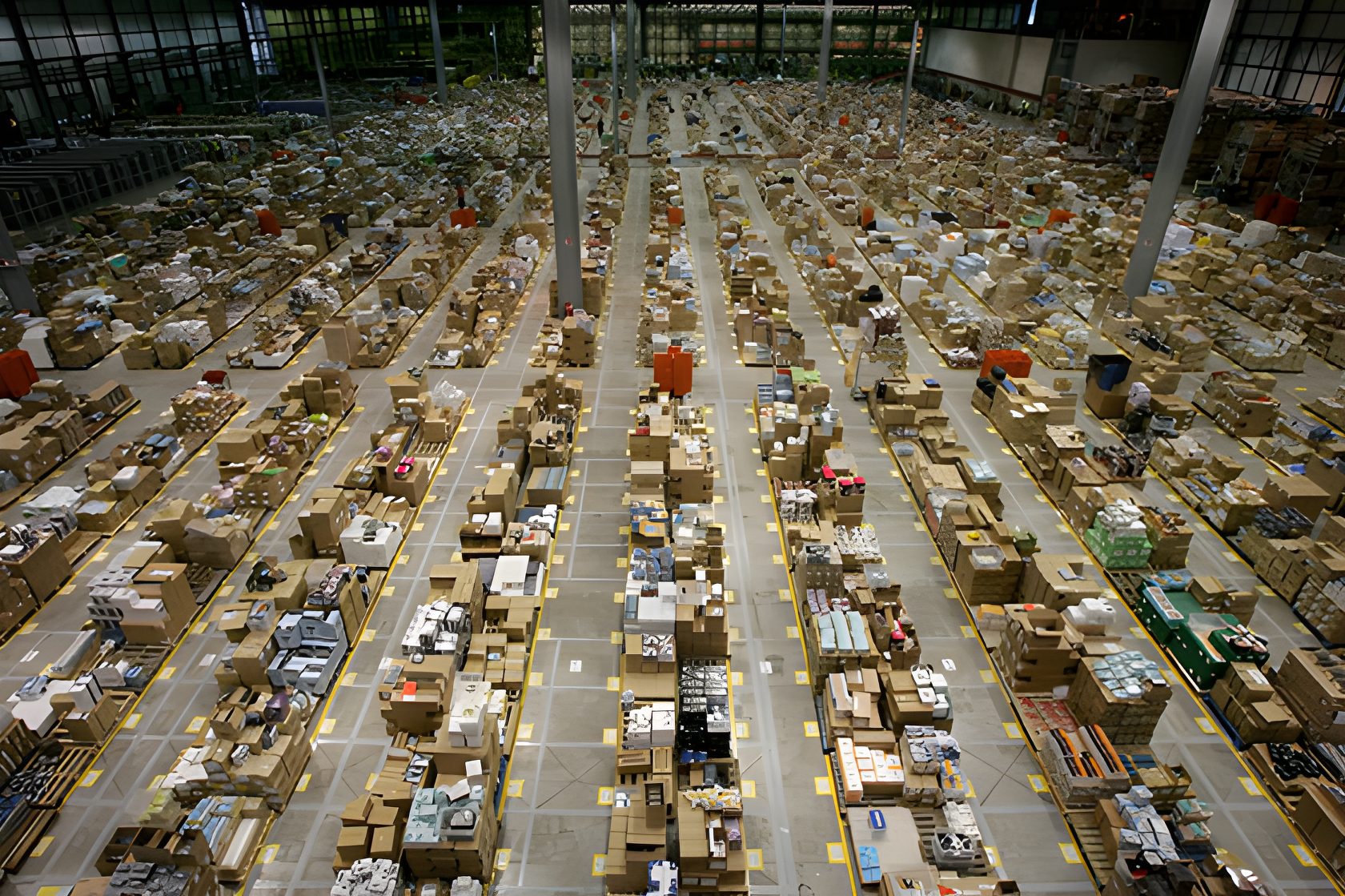
When WIRED got a rare tour of Amazon’s Phoenix fulfillment center years ago, it was the equivalent of peeking into Willy Wonka’s factory — except instead of chocolate, it was stocked with iPhone cables and yoga mats. By 2025, that concept has evolved beyond imagination. These spaces, now the size of small cities, hum with algorithms. Every shelf, every path, every light pattern is calculated to the millisecond. The floor doesn’t just hold boxes; it holds data — real-time updates of human motion, robot traffic, and item flow.
Amazon calls them “fulfillment centers,” which sounds oddly comforting, almost spiritual. But inside, it’s closer to a living organism — part steel, part code, part human muscle. Workers walk up to fifteen kilometers a day while robotic pods glide silently beside them. Cameras track everything, from the rhythm of a worker’s steps to the position of a screwdriver. Efficiency is the religion here; every motion a prayer to the algorithm.
The first time I saw footage of Kiva robots, those orange slabs carrying whole shelves across the floor, I thought: this is what collaboration in the 21st century looks like — beautifully designed, but slightly terrifying. The people who work beside them are part of that same choreography, yet they can never quite match the robots’ pace. There’s a strange tension between human unpredictability and robotic precision, and Amazon’s system depends on balancing the two without collapsing into chaos.
In interviews, employees describe the experience as “synchronized exhaustion.” Breaks are timed. Routes are optimized. Even mistakes are logged as data points. And yet, despite this mechanical precision, the system depends on human adaptability — something machines still can’t simulate. The irony is that Amazon’s greatest strength is not its automation, but its ability to design a workflow where imperfection itself becomes part of the algorithm.
Here’s something most people don’t realize: nearly 60% of Amazon’s sales in 2025 come from third-party sellers. You might think you’re buying “from Amazon,” but often it’s an independent retailer somewhere across the globe, connected through a network so vast and synchronized it makes supply chains from the 1990s look prehistoric. When you order a lamp, Amazon’s system instantly finds the closest warehouse that holds a similar model — sometimes even from a different seller — just to shave off a few delivery hours. The front-end feels seamless, but behind it is organized chaos at planetary scale.

Scot Wingo from ChannelAdvisor once said that people trust Amazon so much they no longer question who actually sells them things. That trust is Amazon’s real currency. It’s also the reason smaller businesses often disappear into its gravity well, becoming both beneficiaries and hostages of the same system.
There’s a darker undertone to this ballet of efficiency. As AI-driven scheduling and motion analytics advance, warehouse workers find themselves measured not by output, but by milliseconds. Miss a scan, slow a motion — and the algorithm notices. Design thinkers often talk about “human-centered design,” but Amazon’s design is “system-centered.” It’s breathtaking in scale, ruthless in logic. From a design perspective, it’s a masterpiece of flow; from a human perspective, it’s a test of endurance.
“Perfection in design is not about adding, but about removing friction. The question is — when do we start removing people?”
I can’t help wondering if the true cost of one-day shipping is not paid in dollars but in attention — in the quiet erosion of empathy when everything must move faster.
What fascinates me most as a designer is how Amazon has turned process into product. The packaging tape, the barcode, the conveyor — they’re all part of the brand experience. The fulfillment center is not just an industrial space; it’s a perfectly choreographed interface. Every design student should study it, not for its ethics but for its structure. It’s an ecosystem where form, function, and data converge into something frighteningly elegant.
There’s a paradox here: the world’s largest retailer doesn’t really sell things — it sells time. The illusion that your desire can skip the waiting line of reality. And that’s design in its purest form — making the impossible feel inevitable.