18
Nov
25
For years, Ukrainian architecture was dominated by concrete—heavy, familiar, and, in some strange way, comforting. It was the material of both stability and stagnation. But today, something subtle yet profound is happening: wood, particularly engineered wood, is pushing its way into the architectural mainstream. And not as decoration or a token eco-friendly gesture, but as a structural core. As someone who has spent time in furniture and industrial design workshops, I’ve watched timber evolve from a tactile craft material into something almost technological. That shift is now happening across Ukraine, and it feels like an overdue realignment.
The public perception of wood in Ukraine has historically been shaped by suburban cottages, outdated stereotypes about flammability, and the idea that “real” buildings must be concrete. But the cultural climate is changing: younger architects returning from European studios bring a completely different view. They see mass timber not as a compromise but as an upgrade—lighter, cleaner, and surprisingly strong. And because the country’s reconstruction needs are enormous, there’s an openness to new systems that would have been ignored a decade ago.

I recently spoke to a young architect from Kyiv who joked that mass timber feels like “a cheat code for rebuilding.” That line has been stuck in my head. CLT compresses time, reduces waste, and shifts the design process closer to manufacturing. Ukraine, with its strong timber resources and engineering tradition, is in the perfect position to take advantage of this shift. For once, timing and context actually align.
Cross-laminated timber is one of those materials that seems like magic until you look closely and realize it’s just smart engineering. Thin layers of wood glued at alternating angles create a panel that behaves more like reinforced concrete than planks. I remember the first time I touched a CLT panel in a London workshop — it felt absurdly sturdy, almost too solid for what it looked like. That mental dissonance is part of why many Ukrainians still underestimate it. Wood is supposed to feel fragile. CLT does not.

There are persistent myths around fire resistance, and I’ve heard every one of them. But the data is boringly clear: mass timber chars on the outside while keeping its load-bearing capacity far longer than steel. Ukrainian engineers who work with CLT talk about this with the quiet confidence of people who have run the numbers a hundred times. The real problem isn’t danger — it’s perception. And perception always lags behind physics.
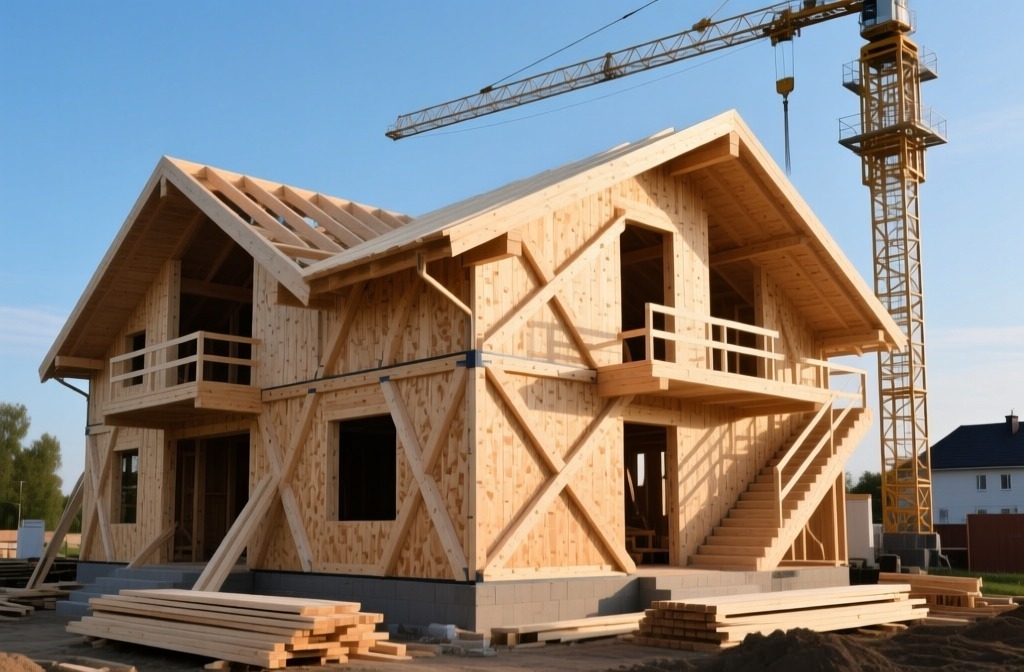
But what really shifts the narrative is precision. CLT turns the messy, unpredictable world of construction into something closer to product assembly. Panels are fabricated off-site, measured to the millimeter, and installed in days. For a country facing labour shortages and urgent timelines, this isn’t just efficient — it’s a lifeline. The technology isn’t a gimmick; it’s a way to rebuild with discipline, speed, and a rare sense of order.
Ukrainian architects aren’t copying European projects; they’re adapting them. And the adaptations are often smarter because they’re forced by necessity. I recently looked at a concept for a modular CLT community hub designed in Lviv — the plan was so elegant it made me jealous. Everything, from structural rhythm to insulation details, was fine-tuned for low maintenance and low cost. That’s the design mindset CLT encourages: strategic simplicity instead of performative complexity.

What’s interesting is how young studios integrate CLT with digital tools. Parametric layouts, CNC-cut joinery, and rapid prototyping aren’t “experimental” anymore — they’re standard tools. Because CLT is predictable and uniform, it invites algorithmic thinking. I’ve seen small teams produce design iterations in hours, not weeks, simply because the material plays nicely with software. For a generation raised on Blender and Grasshopper, this feels natural.
There’s also an emerging hybrid aesthetic that I haven’t seen elsewhere. Ukrainian architects love contrast: raw timber with blackened steel, transparent facades with heavy structural grids, industrial layouts softened by natural textures. CLT gives them a structural system that doesn’t fight their instincts. It’s not Scandinavian softness; it’s something bolder, closer to post-industrial romanticism. And it works.
Concrete is strong, but it’s heavy — physically and symbolically. It represents the old construction culture: bureaucracy, long timelines, and a kind of architectural inertia. CLT feels like the opposite. It’s light, renewable, and fast. It also aligns with the very practical needs Ukraine faces today: speed of deployment, flexibility, and reduced environmental impact. In reconstruction scenarios, these advantages aren’t “nice to have”; they’re decisive.

The environmental case is even stronger. Timber locks carbon instead of producing it, and Ukraine has the forestry resources to support responsible growth. I’ve spoken with engineers who point out that CLT buildings often outperform concrete in thermal efficiency, which directly affects energy resilience — a major issue during wartime disruptions. In that sense, CLT isn’t just a building material; it’s part of a national strategy for self-sufficiency.
And then there’s human psychology. Wooden spaces feel different — warmer, calmer, more grounded. After everything Ukraine has gone through, spaces that feel humane matter. CLT buildings aren’t just efficient; they restore a sense of dignity to architecture. That may be the most underrated advantage of all.
If Ukraine fully embraces CLT, its cities could transform in ways that are difficult to imagine with concrete. Lightweight mid-rise housing, modular public buildings, carbon-neutral schools — all constructed in months rather than years. I’ve seen European prototypes that feel like proof-of-concept Ukrainian neighbourhoods waiting to happen. The future isn’t a forest of wooden skyscrapers; it’s an urban fabric built with speed, intelligence, and a renewed respect for material honesty.
Younger architects are already shaping this future. Their work is optimistic but grounded. They’re not dreaming of utopias; they’re designing systems that work under pressure. And CLT fits perfectly into that mindset. It’s flexible enough to support creativity, but disciplined enough to enforce practicality. That balance is rare.
Ukraine doesn’t need to imitate anyone. With CLT, it has a chance to leapfrog outdated construction norms and define its own architectural future — one that is lighter, cleaner, and unexpectedly bold.
As someone who grew up sketching timber furniture and later designing for industrial manufacturing, I find this shift strangely emotional. Wood is one of the oldest building materials we have, yet here it is — reborn as the future. And in Ukraine, of all places, it might become the foundation of a new architectural identity.