21
Oct
25
I’ve lost count of how many young designers I meet who believe that clicking faster in BIM somehow equals thinking better. It’s an understandable illusion: the tools today feel almost supernatural. You can extrude a form in seconds, generate sections automatically, and stretch a floorplate without so much as turning your head. And yet, whenever I sit with a real project, that glossy efficiency collapses the moment the idea needs to be born.
Architecture in 2025 is brutally digital, yes — but the part of the process that hurts the most, the part where the concept emerges out of chaos, is still painfully analog. Ideas do not emerge from menu bars. They appear when the mind is allowed to move freely, without snapping to orthographic constraints. Even the most advanced parametric system won’t help you decide why a building should exist, what it should feel like, or how it sits in its environment.
When I worked briefly at a studio in London, I noticed a pattern: the strongest designers were always the ones with a notebook full of awkward, half-legible scribbles. The people who relied entirely on software often jumped straight to producing, skipping the uncomfortable conceptual mess that actually generates originality. You could see it in their buildings: technically impressive, emotionally hollow.
The irony is that the more complex architecture becomes, the more crucial drawing becomes. Not for nostalgia, but because nothing else moves ideas from abstract thought to structured intention with the same fluidity. Software delivers geometry. Drawing delivers meaning.
There’s a moment in every project where the model feels like it’s fighting you. You try adjusting a façade rhythm, and suddenly the constraints snap the whole thing out of proportion. Or you chase a sculptural form, only to notice your software pushing you toward whatever is easiest to calculate. That’s the hidden trap: software encourages solutions that are convenient, not necessarily right.
Drawing pulls you out of that rut. When I get stuck inside Rhino or Revit, I physically step away from the screen. I grab a pen and sketch through the problem without rules. It’s shocking how often the idea I needed shows up on paper within minutes, even if the sketch is ugly. Something about the tactile friction of drawing forces the brain to reason spatially rather than numerically.
Software accelerates choices. Drawing generates them.
Take the concept stage: it’s the period where everything is raw, contradictory, unstable. Trying to “model your way” through this chaos is like trying to sculpt steam. The messiness is the point. With drawing, you can follow impulses, jump between scales, exaggerate, distort, even contradict yourself within seconds. That freedom is priceless.

I remember an early project where the team insisted on starting everything directly in 3D. The first week looked promising: clean mass studies, consistent proportions, smooth transitions. The problem? Every option looked like the previous one—variations of the same safe geometry the software gently nudged us toward. When we finally forced everyone to sketch on trace paper, the entire direction changed within a morning. We realized we were designing the wrong building entirely. No plugin would have told us that.
People often think drawing is slow. It isn’t. Thinking is slow. Drawing actually speeds it up because the mind isn’t busy navigating commands; it’s busy solving the problem. When I designed a floating chess pavilion years ago, I didn’t begin with a model or a plugin. I began with weird geometric doodles inspired by the octahedra and tetrahedra I obsessed over when studying descriptive geometry. I wanted the structure to feel like it wasn’t touching the ground — almost like a puzzle suspended above the lake.
Only after I exhausted pages of sketches did I move to laser-cutting the model. The funny part is that the design made sense only because the drawing stage distilled the geometry into something my brain could actually hold. If I had jumped straight to software, I would have ended up with a technically correct pavilion that said nothing.
Drawing forces clarity. You can’t hide behind layers or masked groups. If your form is weak, the sketch exposes it instantly. When I review students’ projects, the fastest way to see who understands architecture is to ask them to sketch their concept from memory. The ones who rely only on software freeze. The ones who draw understand space, not just commands.
And crucially: drawing prevents overdetailing too early. Digital tools tempt you into polishing before the idea is stable. A sketch, on the other hand, gives you exactly the level of precision you need at each stage — no more, no less.
There’s a strange psychological shift that happens when you draw in front of clients. The moment the pen touches paper, their posture changes. They lean in. They begin to feel the building forming in real time, and somehow it feels more true than any photorealistic render. Renders impress. Drawings persuade.
I once sketched a façade upside down because the clients were sitting across the table and I didn’t want to rotate the sheet. It wasn’t a show-off moment; I simply didn’t think about it. But they were stunned. Not because the sketch was beautiful — it wasn’t — but because they realized the idea lived in my head rather than in a file. It builds a degree of trust you cannot fake with software.
Mixed media is another reason drawing matters. The best final boards I’ve seen blend hand sketches with renders, overlays, textures, and quick ink perspectives. It’s the contrast that makes the sheet alive. A slick render alone feels sterile; a sketch alone feels unfinished. The combination feels like design.
And when you present work in schools, there’s always that moment where students pin up their boards and half the drawings look like they came from a software tutorial for seven-year-olds: blue skies, neon grass, shadows going in every possible direction. That lack of drawing literacy is painfully obvious — especially when the concept itself needed a visual language stronger than preset gradients.
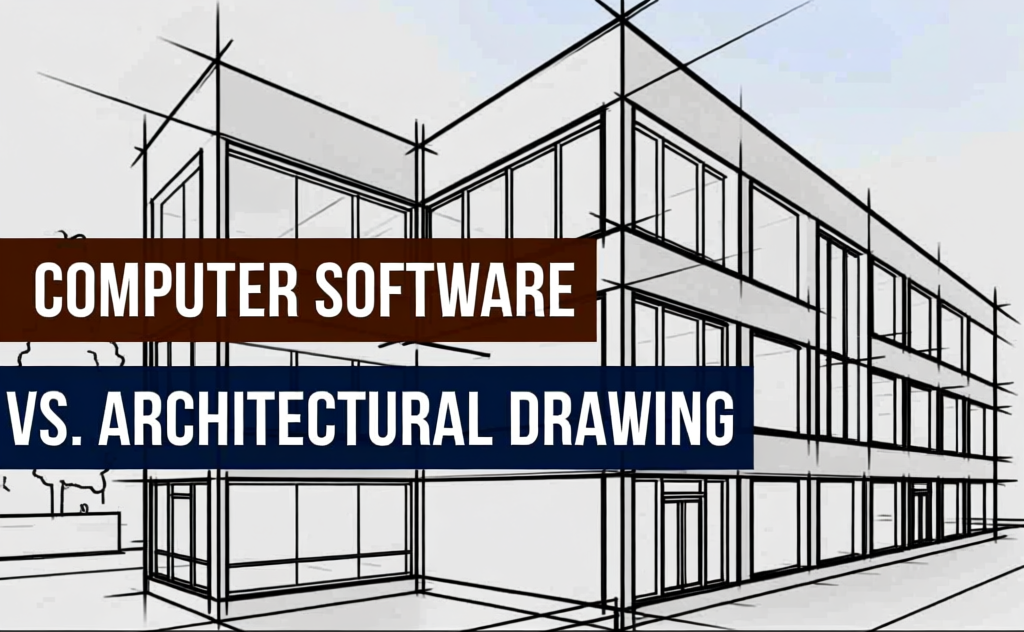
The biggest misconception is that drawing and software compete. They don’t. They occupy different stages of thinking. Drawing is the generator. Software is the amplifier. When you master both, they reinforce each other in a loop:
When you rely on software alone, you end up at the mercy of what the tool can produce. When you rely on drawing alone, you limit precision and speed. But when you treat drawing as the native language of design and software as the technical extension of your hand, your projects gain a depth most architects never reach.
I still remember a one-day modular pavilion assignment years ago. I arrived late, sleep-deprived, and with absolutely no tools. Yet I sketched the entire proposal in two hours. The concept wasn’t groundbreaking, but the drawings communicated with such clarity that a crowd gathered behind me. At the time, I thought they were trying to copy the idea. Later I realized they simply weren’t used to seeing someone draw architecture at speed. They were software-native, not design-native.
The truth is simple: drawing teaches you how to think. Software teaches you how to execute. Master drawing first, and the software becomes effortless. Master only software, and your ideas remain trapped inside its boundaries.
Short answer: no. A software-only architect can survive, but not succeed. The market is full of people who can model a passable building. The ones who rise are those who generate ideas, communicate them convincingly, and navigate uncertainty with confidence. Those are drawing skills.
Knowing tools is important, of course. I use them every day. But software is the executor, not the author. It can polish your vision, accelerate your workflow, and elevate your design — but only if the idea was alive long before the file existed.
A career built solely on software skills ages quickly. A career built on strong drawing, critical thinking, and visual literacy lasts decades. Clients feel the difference. Studios notice it. And you, as a designer, feel it most of all.
So yes, master your BIM, your modeling engines, your renderers. But keep a notebook. Keep a pen. Keep drawing. That’s where architecture begins, and where it still returns when everything else gets too loud.