07
Mar
25
We’ve always been fascinated by the idea of life beyond our fragile blue planet. Every space agency, from NASA to ESA, dreams not only of visiting other worlds but of staying there — for real. Yet, before you can build a city on Mars, you need something far simpler and more essential: air. Oxygen is the currency of life, and producing it sustainably away from Earth remains one of science’s biggest challenges.
For decades, we’ve relied on heavy tanks and chemical systems to keep astronauts alive. But those methods don’t scale. They don’t breathe, grow, or adapt — they’re mechanical, not living. And that’s where design starts to merge with biology. When you treat oxygen not as a product but as part of a living system, something unexpected happens — life becomes a design material.
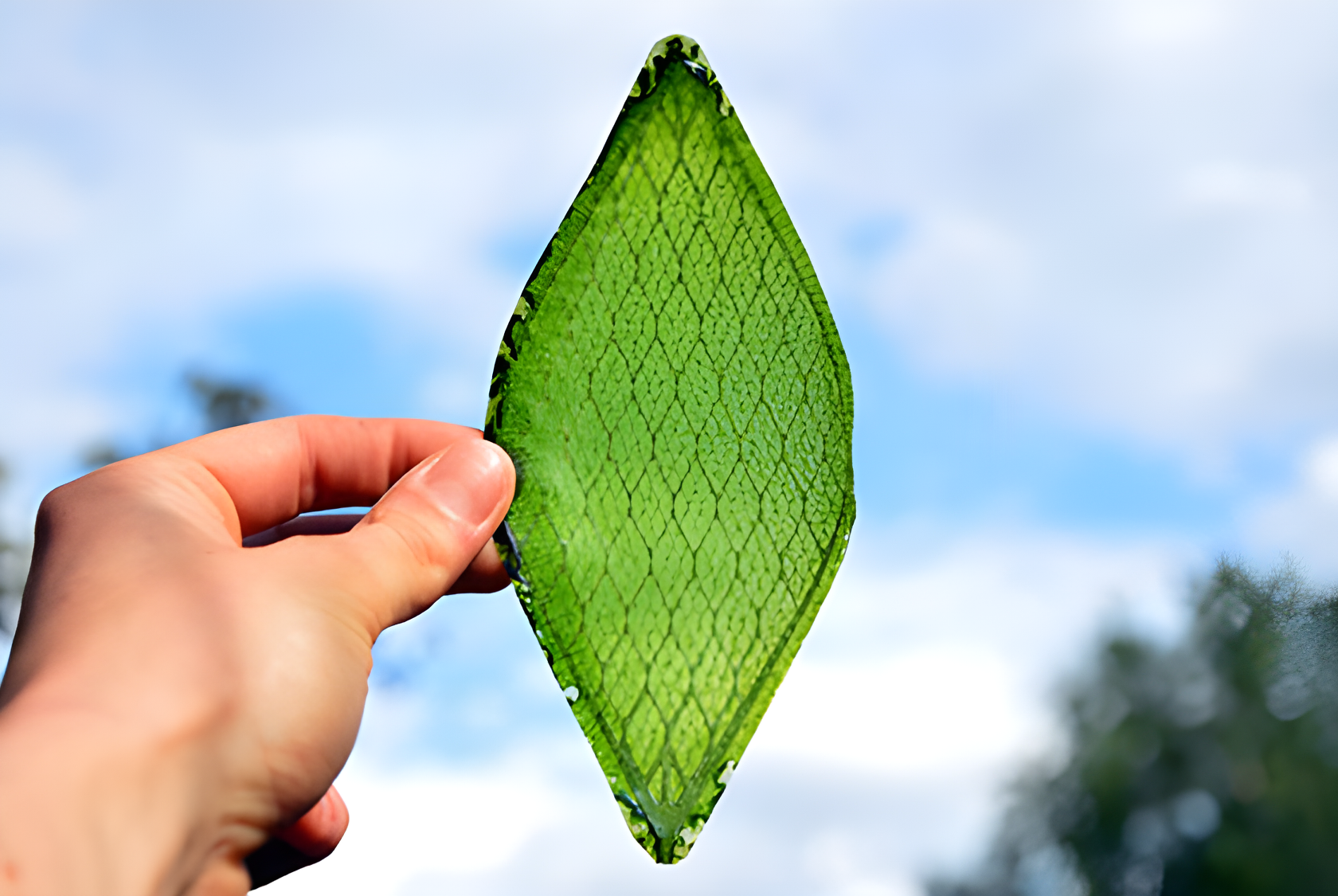
Julian Melchiorri, a graduate of the Royal College of Art in London, might not have been the first to think of artificial photosynthesis, but he was the first to make it look — and function — like life. His creation, known as the Silk Leaf, emerged from a collaboration between designers and biologists aiming to bring the natural process of photosynthesis into man-made environments.

Melchiorri’s background in design gave him a unique perspective. He wasn’t trying to build a machine; he was creating an organism — one that happens to be made of silk and chloroplasts. Using proteins extracted from silk and embedding real plant chloroplasts within them, he developed a lightweight, flexible material that absorbs carbon dioxide and water and releases oxygen when exposed to light.
“It’s not about imitating nature,” Melchiorri once said. “It’s about continuing its logic in places where it doesn’t usually exist.”
The secret behind the Silk Leaf lies in its structure. Natural chloroplasts — the green powerhouses of plants — are suspended within a silk protein matrix. Silk is not just a convenient binder; it’s remarkably stable, biocompatible, and transparent enough to allow light penetration. This combination allows the chloroplasts to keep working even outside their original biological environment.

When light hits the material, it triggers photosynthesis — the same process that keeps our planet’s ecosystems alive. With only a bit of water and light, the synthetic leaf can produce oxygen and even store some of the molecular energy generated in the process. It’s small-scale, yes, but scalable in principle — from personal air filters to large life-support panels in space habitats.
Although Melchiorri’s invention was initially imagined for space exploration, its potential goes far beyond rockets. Imagine skyscrapers with façades that “breathe,” converting CO₂ into oxygen for the city below. Or furniture that quietly filters your home’s air. Even wearable devices could one day integrate these living systems, creating micro-environments around us.

In architecture, designers are already experimenting with bioreactive façades and algae-based panels. The Silk Leaf fits into this same movement — a bridge between ecology and technology. The difference is its accessibility: you don’t need to maintain a lab or a greenhouse; you just need light, a little moisture, and a bit of imagination.
Design has always been about mediation — between user and object, between need and possibility. In biodesign, it becomes a mediator between biology and technology. The Silk Leaf wasn’t invented in a lab full of white coats; it was born in a design studio, where form and function overlap with ethics and aesthetics.
As a designer myself, I find that inspiring. It shows that design can go beyond chairs and screens. It can shape the way we breathe, literally. Melchiorri didn’t just create an object — he proposed a new relationship between humans and the environment: a design that grows, sustains, and coexists.
Today, in 2025, we see the first real convergence between artificial intelligence, material science, and biology. The Silk Leaf feels like an early chapter in a much bigger story — one where “living systems” become part of our designed world. We’re moving toward environments that adapt, self-repair, and regenerate.
One day, astronauts might carry these leaves on their suits, and cities might wear them on their walls. When that happens, we won’t just be living with design — we’ll be living inside it.
In that sense, Melchiorri’s synthetic leaf isn’t just a tool for space travel — it’s a philosophy. A statement that even in the most artificial contexts, life finds a way to participate. Maybe the future designer isn’t someone who simply draws or codes, but someone who cultivates.