18
Feb
25
In 2012, the Internet nearly shut itself down. Sites we used daily—Wikipedia, Reddit, even Google—went dark in protest. The reason? A four-letter bill called SOPA. Back then, it was easy to feel like the fight was over once the law was dropped. But here we are, more than a decade later, facing eerily similar arguments under different names—AI regulation, content moderation, data protection. The tools have changed, the stakes have grown, but the core question remains: who really controls the web?

When I first read about SOPA, I was in school, learning to design objects. I didn’t understand the politics of the Internet, but I felt its pulse—the idea that the web was a creative playground, not a fenced garden. Thirteen years later, that feeling still defines my relationship with design and technology.
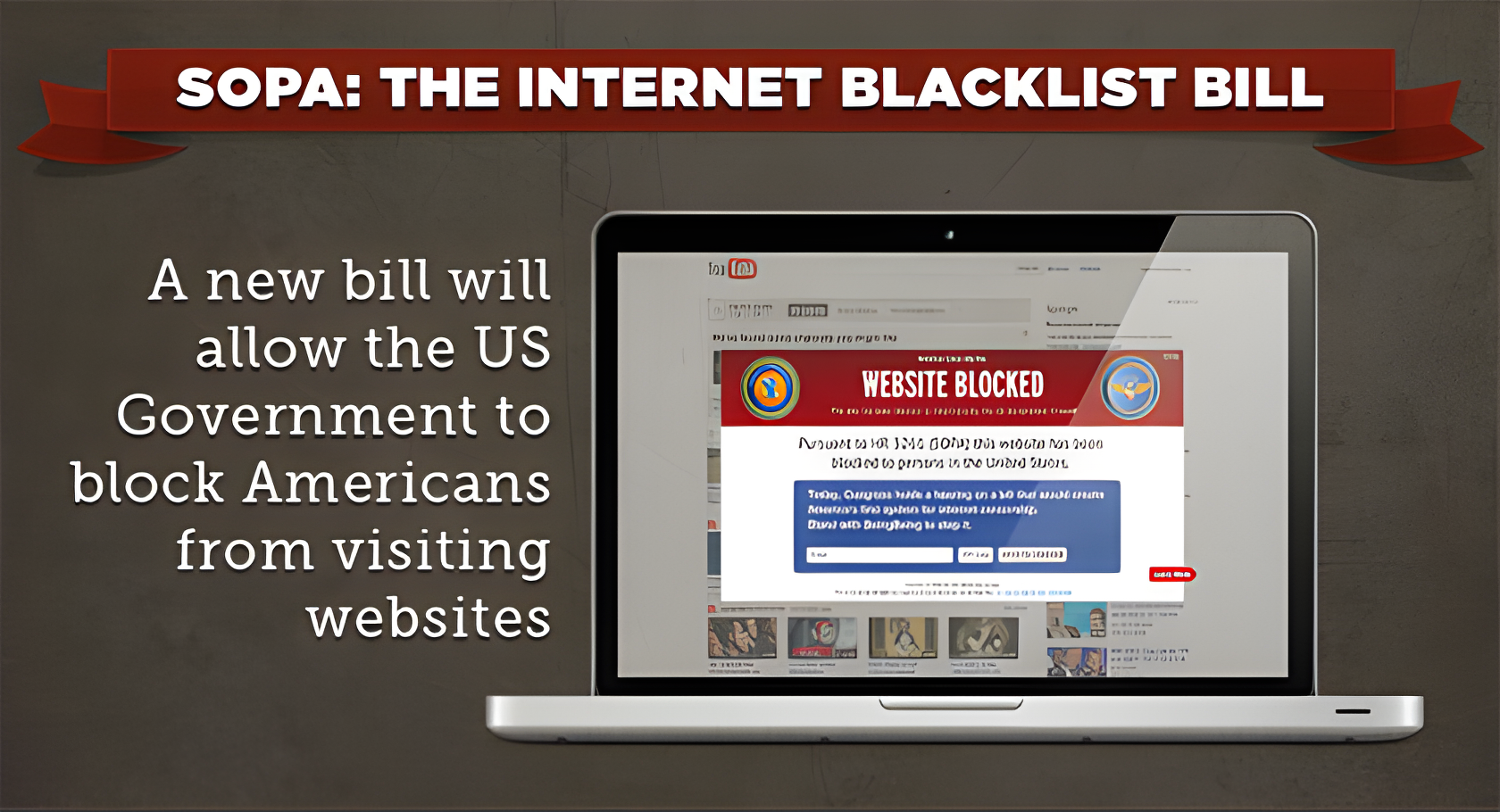
SOPA—short for the Stop Online Piracy Act—was introduced in the U.S. House of Representatives in 2011. The bill aimed to give authorities more power to block sites accused of hosting pirated content or counterfeit goods. On paper, it sounded like protection for artists and creators. In practice, it was a loaded weapon against the free and open Internet.
The danger lay in its vagueness. A website could be shut down not for hosting illegal content itself, but simply for linking to it. That meant platforms like YouTube, Tumblr, or Reddit—built on user-generated content—would constantly walk on legal eggshells. For many, SOPA wasn’t about piracy at all. It was about control, and who had the right to decide what stays visible online.

On January 18, 2012, the Internet went silent. Wikipedia blacked out its entire English version, showing only a dark protest message. Google placed a black rectangle over its logo. Thousands of smaller sites joined in solidarity. It was the largest digital protest in history. The message was loud, visual, and unmistakably modern: this is what a censored web looks like.
“Imagine a world without free knowledge.” — Wikipedia blackout message, January 2012
The blackout worked. Millions of users contacted their representatives. The bill lost support. SOPA was shelved. But more than that—it marked the first time the Internet defended itself as a living, breathing organism.
Fast forward to now. The new wave of online regulation focuses on AI-generated content, misinformation, and copyright claims from machine-learning datasets. The irony? Some of the same arguments that killed SOPA are now being used to justify stricter controls. Platforms are automating content takedowns. Algorithms act as judges. And “protection” once again risks becoming censorship in disguise.
The SOPA debate wasn’t just about piracy—it was about the right to share, remix, and reinvent. That right is being quietly rewritten as technology advances faster than legislation can follow. And if we’re not careful, the creative Internet we grew up with may slowly fade into a curated feed.
As someone who works in design, I see this tension everywhere. Every creative field deals with ownership, inspiration, and imitation. But design, like the Internet, thrives on influence. You take an idea, reshape it, mix it with your own. That’s how progress happens. If every pixel or paragraph becomes a potential lawsuit, creativity freezes.
There’s a fine line between respect and restriction. SOPA tried to draw that line with legal ink. The web community redrew it with collective action—and with design. Those blackout pages weren’t just political—they were beautifully simple, powerful visual statements. The design itself became the protest.
As a designer, I can’t help admiring how minimal and iconic the protest imagery was. The blacked-out logos, the censored bars, the negative space—it all communicated silence better than any speech. It showed that design can mobilize people faster than any manifesto. That lesson feels even more relevant in the era of visual overload, when everything competes for attention.
The SOPA protests were a masterclass in digital visual language. They proved that even in a sea of content, clarity and emotion still cut through.

SOPA taught us that the Internet isn’t guaranteed to stay open—it stays open because we defend it. But in 2025, most people scroll past black banners and “terms of use” updates without a second glance. The activism spirit that once united tech giants and tiny blogs feels distant.
Maybe it’s time to remember that the freedom to create, share, and remix is also a form of design freedom. It’s what allows voices like mine—or yours—to exist. The blackout may be history, but the light it protected is something we still need to keep on.